My SaaS implementation story started as a favor.
A shared investor introduced us to a portfolio company that was selling like gangbusters but failing when it came to implementing their new customers and collecting that first revenue check.
Leadership recognized that their implementation capacity was tested as the pipeline matured, and they wanted to get ahead of it before it became a bigger problem. So, they brought us in.
At first, the engagement felt tactical. We were there to reduce an implementation backlog and stabilize the situation.
But as we got deeper into their delivery model, something became clear: what they were navigating was not a one-time challenge. It was a structural pattern, one that shows up at predictable moments in the life of a SaaS company. And most companies do not see it coming until it is already costing them.
I have since watched this same pattern play out across fintech and private capital-focused SaaS platforms for years. And what each of those experiences reinforced is this: implementation is not a support function. It is a revenue realization engine. If it slows, ARR realization slows. If it is inefficient, margin erodes. If it is inconsistent, customers churn. We’ll dive into more of this later on.
The operators who understand this build better businesses. Here is what the pattern looks like, where it tends to break, and what the most effective teams do about it.
The SaaS Arch
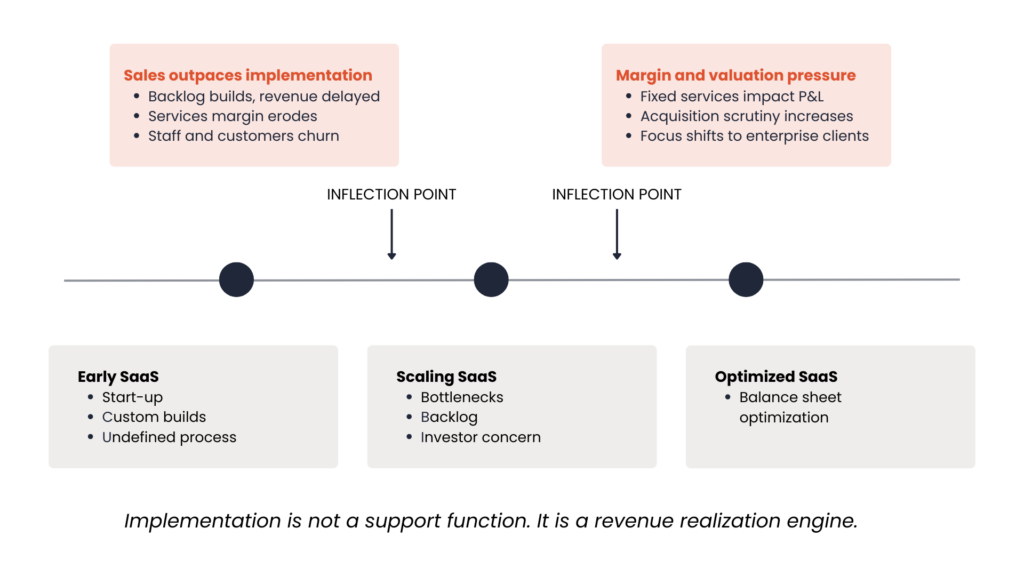
Most SaaS companies move through a recognizable arc.
In the early stage, implementations are custom by necessity. The product is still evolving to match customer needs, every implementation is a little different, and the only people who can do it are the people who built it. That’s fine. It’s expected.
Then, sales accelerate, and that’s when the tension starts.
You hire more implementation consultants and project managers. That takes time. Meanwhile, you’re trying to turn your one-off implementation process into something repeatable and predictable. And underneath all of this, client demand is variable: some quarters you are stretched thin, others you are sitting on bench time that you are paying for. You’ve just created a significant overhead problem for yourself.
The signals are recognizable once you know what you’re looking for:
- Sales consistently outpaces implementation
- Implementation delays postpone revenue recognition
- Customers churn before the relationship has a chance to generate returns
- Staff burns out and churns
- Services margin drags down overall operating margin, even as ARR grows
Some companies grind through this phase and come out on the other side. But the issue has a way of showing up again: usually right when you begin preparing for an M&A event or institutional investment. Now the second set of signals appears:
- Enterprise customers are consuming most of your delivery bandwidth, leaving smaller accounts underserved
- Acquirers and PE firms are scrutinizing your subscription-to-services ratio
- Your valuation is being driven by subscription revenue, not services revenue while your services costs are working against you
From the outside, revenue is growing. On the inside, friction is compounding.
The Reframe That Changes Everything
Here’s what became crystal clear to me after watching this pattern play out repeatedly: implementation is not a support function. It’s a revenue realization engine.
Think about what that means in practice. If implementation slows, ARR realization slows. Every signed contract sitting in a backlog is revenue you’ve earned on paper but haven’t yet collected. If implementation is inefficient, margin erodes in ways that often do not show up clearly until you are preparing financials for a raise or a sale. And if implementation is inconsistent, adoption suffers. Customers who don’t fully onboard don’t fully expand. And eventually, they churn.
The companies that navigate this well don’t treat implementation as a cost of doing business. They treat it as a strategic function and one that deserves the same operational rigor as sales or product.
Two Models That Work
There are two approaches I’ve seen work consistently for SaaS companies looking to solve this problem without taking on the full burden of scaling an internal services org.
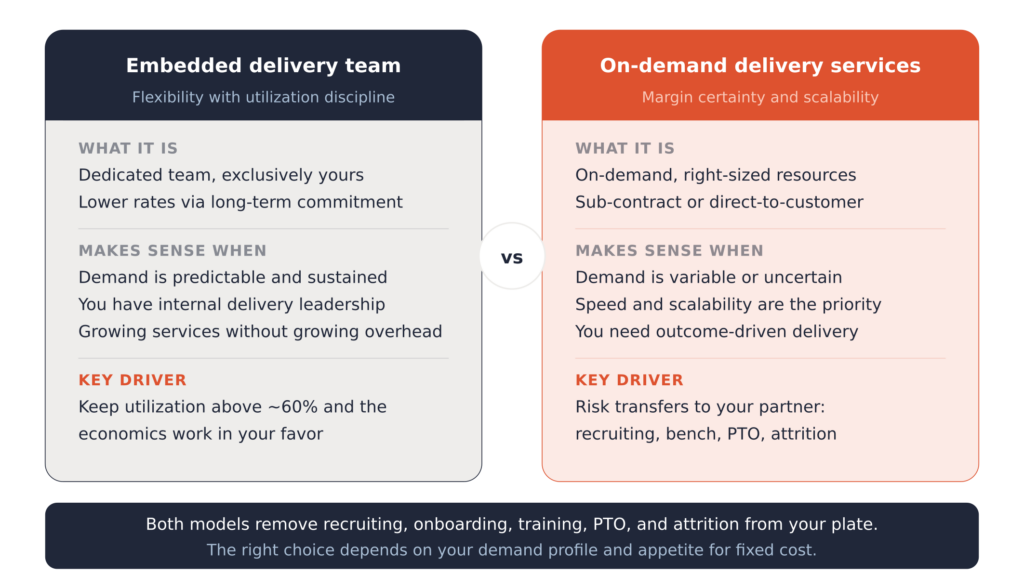
Embedded delivery teams are fully dedicated resources who implement your product exclusively. Because of the long-term commitment involved, you typically get better rates and deeper product familiarity over time. This model works best when your implementation demand is predictable and sustained, and when you have internal leadership with the capacity to manage an extended team. The financial key is utilization: if you can keep an outsourced team occupied at roughly 60% or higher, the unit economics work in your favor.
On-demand delivery services are the better fit when demand ebbs and flows. These resources are typically positioned to your end customers as a certified partner rather than a vendor extension, which preserves the integrity of the relationship. This model gives you scalability without the fixed cost structure, and it transfers the risks of recruiting, onboarding, bench time, PTO, and attrition to someone else.
Both models share a critical advantage: they let your internal team stay focused on what you’re actually building to sell. Implementation expertise is a different discipline than product expertise. Trying to maintain both at scale, inside the same org, under the same cost structure, is where most companies get into trouble.
How to Know If You’re at an Inflection Point
Some of the signals are ones we touched on above: sales outpacing implementation, services margin dragging on operating margin, enterprise accounts consuming most of your delivery bandwidth. Those are the most visible ones. But there are others that tend to surface earlier, in quieter ways, before the pressure becomes obvious to the broader organization.
If any of the patterns in this piece feel familiar, we put together a deeper resource that helps you assess your specific situation. It walks through the full set of indicators, what each one means in practice, and how to think about urgency.
7 Signs You’ve Hit an Implementation Inflection Point checklist here.
Checking many or all of the boxes? You are likely at an implementation inflection point.
Reach out to Monarch. We support SaaS platforms through embedded delivery teams and on-demand implementation services, and we can help you figure out which model makes sense for where you are. Start the conversation here.