Sit through enough AI conversations at mid-market GPs, and you notice they’re all the same conversation. Which tool. Which vendor. Which license tier. Whether to wait for the platform to ship it or go build something now.
Those are real decisions, but none of them produce a true advantage. Whatever capability you’re evaluating right now, the firm down the street can buy the same one by next quarter. The models converge. The market data providers sell to all of you. Platform features arrive in everyone’s instance on the same release schedule.
So, the useful question isn’t what AI can do for your firm. It’s what AI can do for your firm that it can’t do for anyone else’s.
There’s exactly one answer, and you already own it.
What Your Competitors Can’t Buy
Ask most platform owners what’s in DealCloud, and they’ll describe the pipeline: what’s live, what stage, what it’s worth. That’s the present tense, and it’s the part everyone looks at because it’s the part that goes in the Monday deck.
The history and context are the part most firms don’t have the time to review. It’s also where the answers live:
- How long your deals actually sit at each stage, which is the only honest way to know when one has stalled.
- Which sourcing relationships produce deals that close, versus deals that die at IOI.
- What you passed on, at what stage, and why. Your firm has a thesis. This is the record of whether it’s the thesis you actually execute.
- How origination volume moves by month and by sector, which is the difference between “August was quiet” and “we have a problem.”
None of that needs a clever model. It needs your own records to be complete enough to read.
That’s the gap, and it’s one of the places where we’ve been building. Two examples of what that looks like in practice: getting deals captured properly on the way in, and getting the history read back on the way out.
What We Built, Part One: Deal Ingestion
Most deals your firm sees start as an email. A banker sends a teaser. A sponsor forwards a CIM. Someone reads it, opens DealCloud, and types it in by hand.
The obvious cost is the time. That’s real, and nobody took an associate seat to do transcription. But it isn’t the argument worth taking to a partner.
The argument worth taking to a partner is this: capture quality moves inversely with activity. When your team is busiest, records get thin and late. The teaser gets read, the call gets taken, the deal gets worked, and the record gets a company name and a stage. Everything else waits for a quieter week that usually doesn’t arrive.
So your history is systematically thinnest during your highest-volume periods. Every number you compute from it skews toward your quiet quarters. The exact periods that most need explaining are the ones your data explains worst.
You can’t fix that with a reminder email. The cause isn’t carelessness. It’s that a person had something more valuable to do.
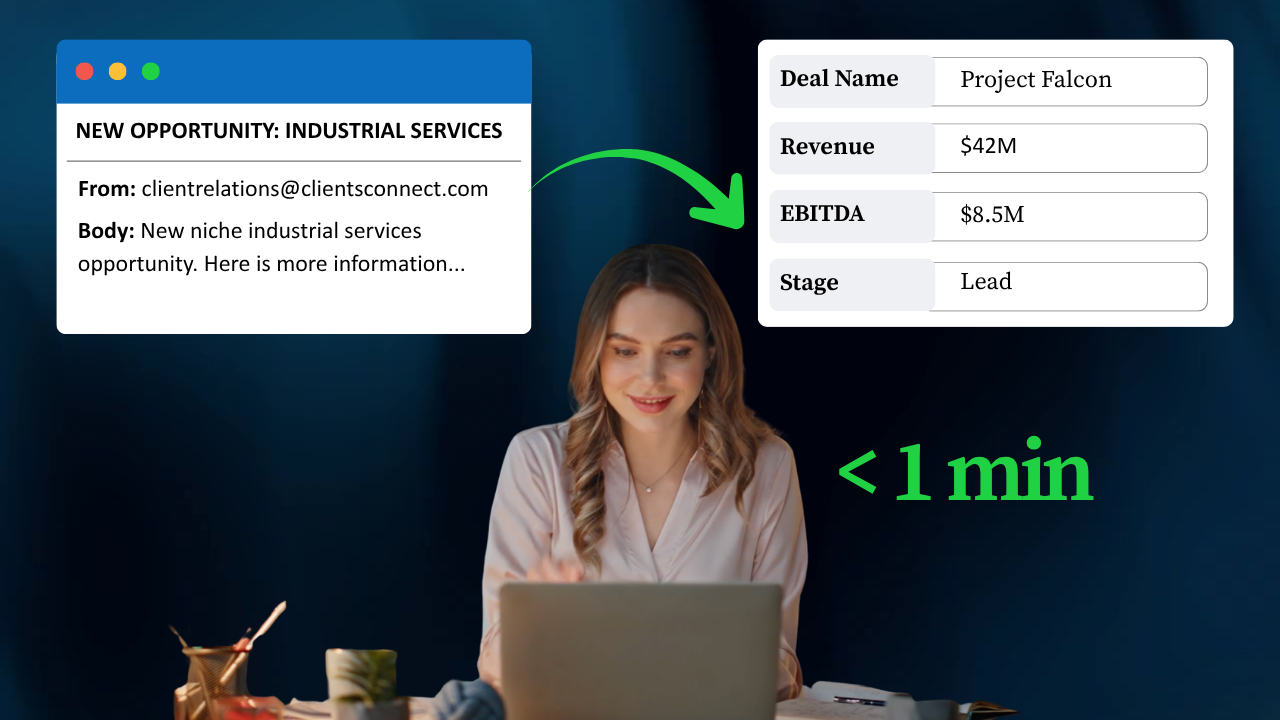
The ingestion workflow we’ve built changes the shape of the problem. An agent watches the intake mailbox and writes structured records: company, sponsor, revenue, EBITDA, source advisor, deal stage, a written summary of the opportunity, documents attached. It handles the email that’s been forwarded three times with commentary stacked on top, where the actual opportunity is buried three layers down. It checks whether the deal already exists before creating anything, so a follow-up on an existing opportunity enriches that record instead of spawning a duplicate. And when what arrives is a conference invitation or a newsletter, it writes nothing at all.
Two things get configured around how your firm actually works, and they aren’t settings you inherit. Which fields are mandatory, because the agent should be capturing the ones your reports actually depend on rather than a generic set. And what counts as a duplicate, which is a policy question about how your team defines the same opportunity, not a checkbox.
The result is that every deal gets logged, with the fields you need, in the same shape, regardless of how busy the week was.
Which matters mostly because of what it feeds.
What We Built, Part Two: A Pipeline Report That Knows Your History
You almost certainly have a weekly pipeline report already. It probably works fine. It tells you what’s open and what it’s worth.
What it doesn’t easily tell you is whether this week is normal.
That’s not a criticism of the report. It’s a structural limit. Answering it means reading this week against your own deal history, and nobody has a free afternoon every Monday to go hunting for a pattern in months and years of records.
Using DealCloud’s MCP server, we built a report that does the hunting. It runs on a schedule, reads the full deal history, and delivers the comparison rather than the snapshot:
- Origination pace against its own baseline. Not “eleven new deals this month,” but eleven against a twelve-month mean of twenty-eight, with the last new deal logged five weeks ago. That’s the difference between a slow month and a stall, and it’s the kind of thing you’d rather find in week one than week five.
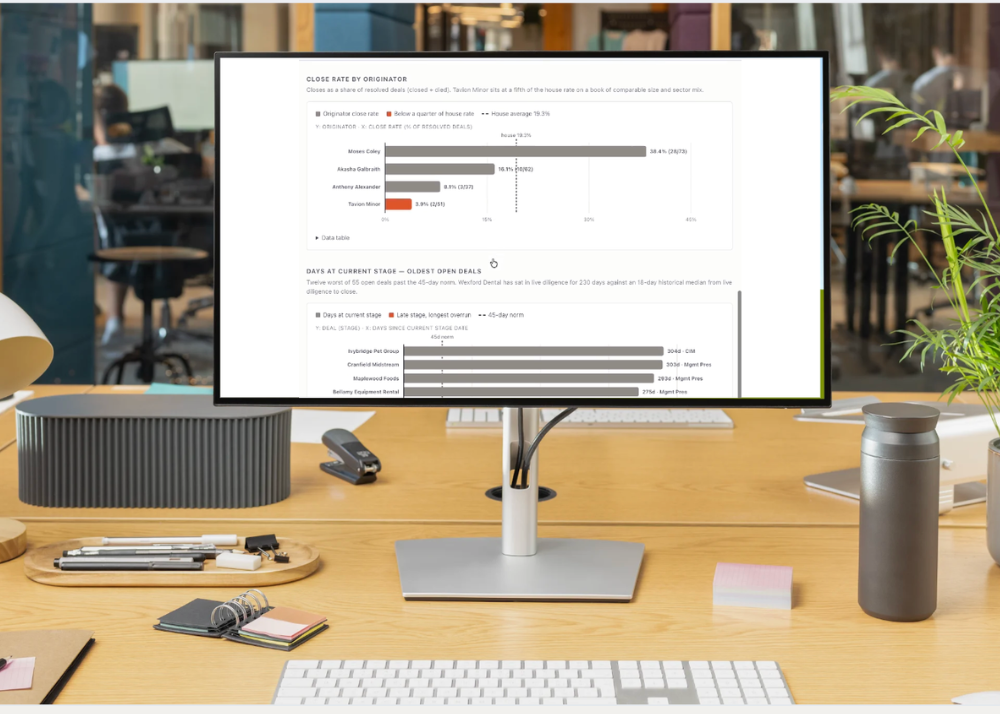
- Deals stalling against your firm’s own medians. A deal sitting at 230 days in live diligence isn’t obviously wrong until you know your median from live diligence to close is eighteen. Nobody buried that deal. It just stopped being the thing anyone looked at, and no weekly snapshot flags it, because it’s open and it’s been open the whole time.
- Patterns across the team. One originator closing at a fraction of the house average on comparable deal sizes in the same sector. That’s a process question rather than a sourcing one, which makes it a coaching conversation you can have this Monday instead of at the quarterly review.
Every one of those findings is a comparison, and every comparison is drawn from your own records. The baselines aren’t benchmarks from an industry survey. They’re your firm’s, computed from what your firm actually did.
It runs on read access to data you already own, inside your own environment, and arrives in the same shape every week.
Where This Goes Next
These two workflows are examples, not a menu. What’s worth building at your firm depends on how you source, what your reports actually need, and where the manual work is costing you most.
This is the kind of work we do. We scope the workflow, build it against your instance, and configure it around how your team operates.
What makes any of it hold up is the platform underneath. Across 4,500+ DealCloud projects, we’ve built DealCloud into the system of record firms actually run on, along with the integrations feeding it. AI workflows are only as good as that foundation and the connections around it.
If you’re looking for platform experts who also know private capital markets, reach out to our team.